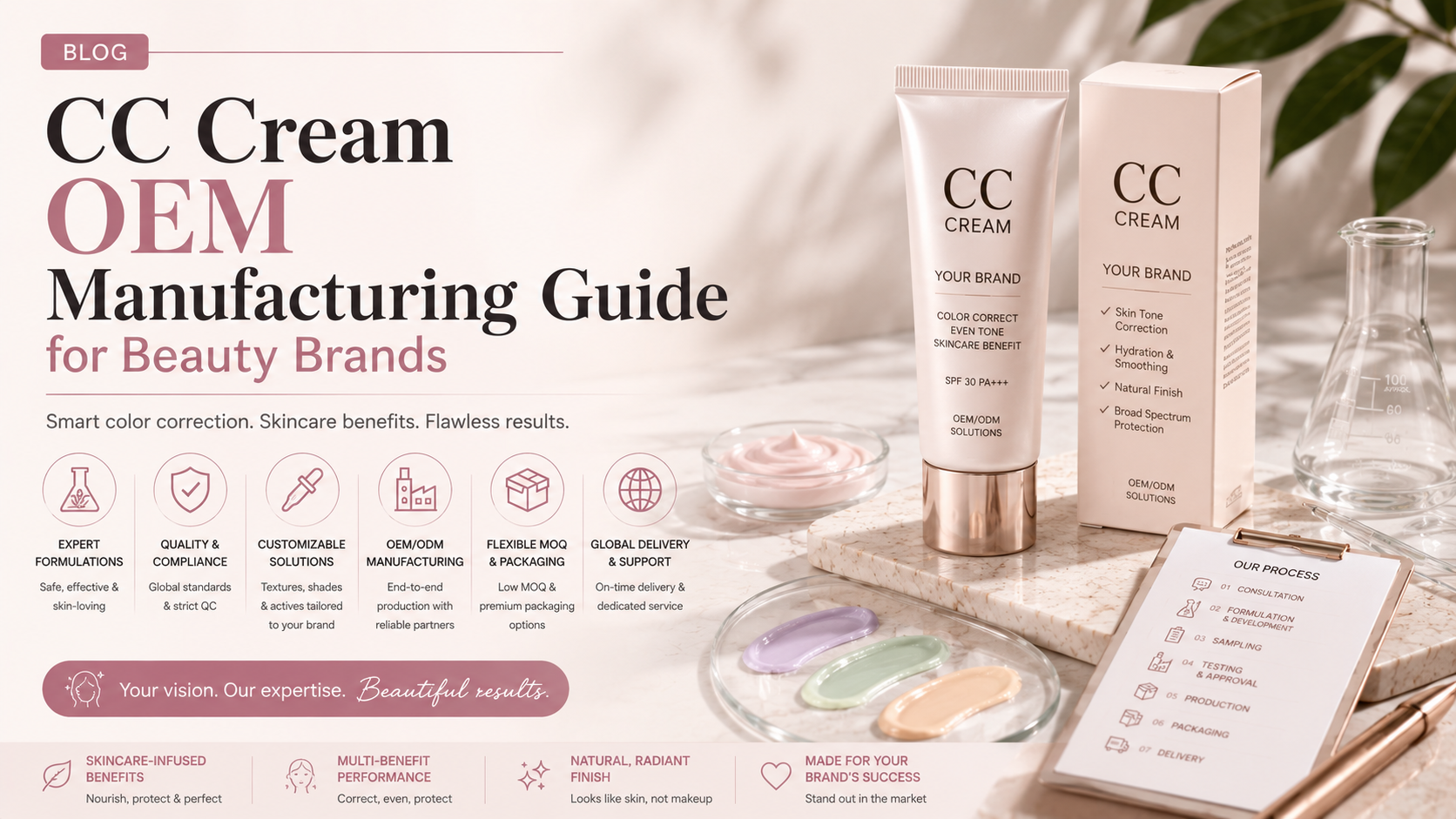
).
Market data buyers should read before briefing a BB cream factory
The BB cream market is forecast to grow at an 8.5% CAGR from 2024 to 2030, which is faster than many broad beauty categories (Source: ). Asia Pacific held 41.7% of global BB cream revenue in 2023, which matters because many BB cream texture expectations still come from Korean and wider Asian complexion routines (Source: ).
Grand View Research also reports that the global color cosmetics market was USD 100.2 billion in 2025 and is expected to reach USD 148.7 billion by 2033 at a 5.1% CAGR (Source: ). Within that market, face color cosmetics accounted for 38.2% of 2025 revenue, which tells me that complexion still sits at the center of makeup baskets (Source: ).
The same color cosmetics report says mass/economy products held 55.1% share in 2025, while prestige/luxury color cosmetics are expected to grow at a 6.9% CAGR from 2026 to 2033 (Source: ). That split is useful for BB cream sourcing because the product can work as an affordable everyday SKU or as a premium hybrid base, depending on shade range, packaging, claims, and finish.
For 2026 product planning, Vogue Business reported that foundation is the fastest-growing facial makeup category and is projected by Euromonitor to reach USD 20 billion by 2027, with 4.5% growth (Source: ). That does not make BB cream the same as foundation, but it confirms the bigger buyer behavior: people still want base products, only lighter, more flexible, and more skin-like.
What separates a good BB cream formula from a weak one
BB cream is not just foundation diluted with moisturizer. A good formula has to balance pigment dispersion, slip, oil control, hydration feel, shade stability, and packaging compatibility. I work with ZM Beauty on color cosmetics projects, and the most common early mistake I see is when a buyer asks for “natural coverage” without defining coverage level, finish, wear time, SPF direction, and skin type target.
A stock BB cream direction usually starts with light to medium coverage, a flexible emulsion base, film formers for wear, humectants such as glycerin or hyaluronic-acid style hydration systems where suitable, and powders or oil absorbers for a soft finish. If the brand wants a clean, vegan, cruelty-free, or preservative-free direction, we can discuss it as a formulation goal, but I do not promise that every BB cream can meet every positioning at once. Formula safety, preservation, pigment load, and target market rules still decide what is possible.
The SPF question needs special care. Grand View Research notes that BB creams often include UV-protection positioning and that the SPF 15-30 segment had the largest revenue share in 2023 (Source: ). But SPF claims are regulated differently by market. For some buyers, it is better to create a “daily comfort base” without a front-of-pack SPF claim than to create a claim that the destination market cannot support.
Packaging also changes the formula. Tubes are common because they control air exposure and work for low-viscosity emulsions. Pumps give a more premium feel but add compatibility checks. Cushion formats can be attractive, but they raise questions about sponge saturation, preservative stress, refill logic, and freight. Before I recommend packaging, I need to know whether the buyer wants a drugstore-style tube, a masstige pump, or a compact product for a K-beauty story.
Trend drivers behind BB cream demand
The first driver is hybrid base makeup. Grand View Research says products such as tinted moisturizers, BB creams, and serum foundations are gaining traction because consumers want coverage plus hydration or SPF-style benefits in fewer steps (Source: ). For a brand, that means the brief should not only say “BB cream.” It should say what job the BB cream replaces in the customer’s morning routine.
The second driver is shade flexibility. The color cosmetics report says complexion buyers are seeking undertone accuracy and shade matching, especially in foundation and concealer (Source: ). BB cream can use fewer shades than foundation, but it still needs disciplined undertone planning. Three vague shades will not satisfy a market that already understands warm, cool, olive, and neutral undertones.
The third driver is daily-use convenience. Grand View Research states that lightweight and quick-application formats such as skin tints, cream blushes, lip balms, and stick products are influencing color cosmetics demand (Source: ). BB cream fits that behavior well if it spreads fast, layers without pilling, and looks acceptable under indoor lighting and mobile cameras.
The fourth driver is digital discovery. Online/e-commerce color cosmetics are expected to grow at a 6.7% CAGR from 2026 to 2033, supported by virtual try-on, reviews, tutorials, and shade comparison (Source: ). A BB cream line therefore needs clear shade names, swatch photos, texture videos, and claim language that does not collapse under customer review.
How I position ZM Beauty for BB cream OEM work
I work with ZM Beauty as a one-stop OEM/ODM beauty supplier founded in 2017, with headquarters in China, a UK branch, and Korea factory support for high-end customization. For BB cream, the closest ZM site reference is the , which lists private label OEM/ODM foundation capability and shows that ZM’s cosmetics range goes beyond the products displayed online. ZM’s highlights lightweight breathable texture, long-lasting wear, skin-tone adaptation, and customizable formulation.
For broader private-label context, I also reference the , the , the , and the when buyers are building a full color cosmetics range. These links matter because many buyers do not source BB cream alone. They pair it with blush, lip products, highlighter, or seasonal kits.
MOQ discipline is important. For color cosmetics, stock products are generally 200-1000 pieces, custom formula is 600-1000 pieces, and fully custom development is 6000-12000 pieces. Liquid foundation custom formula MOQ is 1000 pieces. Because BB cream is a base-makeup product close to foundation, I would confirm the final MOQ with the account manager after formula, shade count, packaging, and documentation needs are clear.
ZM Beauty can discuss custom formula, texture, color, packaging design, logo and label support, product compliance materials, samples, quotations, and cooperation workflow. For color cosmetics, I do not claim completed CPSR certification. We can assist by providing required materials so clients can register CPSR themselves where needed. We can discuss ISO 22716, GMPC, SGS, Intertek, MSDS, and COA support where applicable.
Here is the honest limit: ZM Beauty does not focus on eyeshadow palettes, perfume, body lotion, body wash, soap, hand sanitizer, shampoo, conditioner, hair styling products, makeup brushes, beauty sponges, beauty tools, devices, or children’s products. This Blog strategy is for color cosmetics OEM/ODM only. Buyers who need a one-off ultra-low test below realistic MOQ, medical claims, or unsupported categories should not treat this as the right inquiry path.
Five sourcing questions to ask before ordering BB cream
-
What coverage level and finish can your lab repeat batch after batch? A BB cream that looks beautiful in one sample can fail if pigment dispersion changes in production. I ask for target coverage, finish, viscosity, and wear-time references before we lock the benchmark.
-
How will you manage shade and undertone with a small first range? BB cream may not need 40 shades, but it still needs a rational shade map. Ask how the supplier tests oxidation, undertone drift, and photo appearance.
-
Which claims are formula claims and which claims need market review? Hydration, SPF, non-comedogenic, vegan, clean, and sensitive-skin language carry different proof needs. I prefer buyers to separate marketing wishes from claims that need documents.
-
What packaging has already passed compatibility with this base? Tubes, pumps, and cushions do not behave the same way with emulsions. Ask about leakage, air exposure, fill tolerance, and accelerated stability checks.
-
What MOQ applies to stock, semi-custom, and fully custom versions? The cost structure changes sharply across customization levels. I want buyers to know whether they are choosing a fast launch or a new formula platform.
Risks and downsides buyers should not ignore
BB cream can become too vague. If the formula is not hydrating enough for skincare buyers and not high-coverage enough for foundation buyers, it sits in the middle without a clear repeat reason. That is why I push buyers to define the exact user: oily-skin office customer, dry-skin winter customer, teen first-base customer, or natural-finish premium customer.
Shade underdevelopment is another risk. A small shade range saves MOQ, but it can weaken conversion if undertones are poorly chosen. A third risk is claim overreach, especially around SPF, acne, sensitive skin, or “all skin types.” Finally, base formulas are stability-sensitive. Heat, freezing, pigment settling, pump clogging, and separation must be tested before the buyer scales.
Why BB cream is still worth building
-
It connects makeup and care in a format consumers already understand, supported by an 8.5% forecast CAGR for BB cream (Source: ).
-
It fits daily-use routines, which helps repeat purchase and reduces dependence on one viral launch.
-
It can anchor a full complexion range with blush, contour, highlighter, lip care, and setting products.
-
It gives new brands a simpler shade architecture than full foundation, while still letting them tell a serious base-makeup story.
FAQ
What is the usual MOQ for BB cream OEM?
For color cosmetics, stock products are generally 200-1000 pieces, custom formula is 600-1000 pieces, and fully custom development is 6000-12000 pieces. For base products close to liquid foundation, custom formula MOQ may need confirmation around the 1000-piece rule.
Can ZM Beauty customize the BB cream formula?
Yes, we can discuss texture, finish, shade, hydration feel, scent direction, active-ingredient direction, packaging, and label design. Final feasibility depends on formula safety, target market, claims, and MOQ.
Can I make BB cream with SPF claims?
Possibly, but SPF claims depend on destination-market rules and testing. I would first decide whether SPF is a front-of-pack claim or only part of the formula direction.
How many BB cream shades should a new brand launch?
It depends on market and budget. I usually prefer a small but logical undertone map over random light, medium, and deep shades.
What quality checks matter most?
Stability, microbial control, shade consistency, oxidation, packaging compatibility, filling accuracy, and wear testing matter most. For base makeup, pigment behavior under heat and time is especially important.
Can BB cream be part of a wider color cosmetics line?
Yes. Many buyers pair BB cream with blush, lip care, lip color, highlighter, or contour because complexion products help structure the full routine.