The Middle East is no longer a secondary beauty market for global retailers. Ulta Beauty announced a Middle East launch with Alshaya, planned stores in Kuwait and Dubai, and an 80-brand assortment for the region after posting USD2.8 billion in Q2 2025 net sales (Source: ). For private label makeup buyers, that means competition is rising and supplier choice has to become more precise.
I work with ZM Beauty on color cosmetics OEM/ODM projects, and I see Middle East buyers ask for three things at the same time: premium-looking packaging, practical MOQ, and products that can move through retail, salon, e-commerce, and distributor channels. This article ranks supplier types by commercial fit, not by hype.
Market overview
Beauty groups are investing in the region because the customer is educated, social, and willing to compare global brands. Dolce & Gabbana Beauty opened its first standalone beauty boutique in Dubai Mall, said the Gulf is one of its most important regions, and planned up to 20 standalone beauty boutiques across the Gulf over three years, mainly in the UAE and Saudi Arabia (Source: ). Ulta's first Middle East rollout targeted The Avenues in Kuwait, Mall of the Emirates, and Dubai Mall (Source: ). Puig reported EMEA revenue of EUR2.8 billion in 2025, equal to 55% of group revenue, and makeup growth of 13.7% to EUR845 million (Source: ).
At the same time, buyers cannot ignore margin. Coty reported fiscal 2025 revenue down 2% to USD5.89 billion and called out pressure in mass color cosmetics (Source: ). This is the warning for distributors: demand exists, but weak differentiation and too many confusing launches can hurt sell-through.
Middle East manufacturing and supply map
For color cosmetics, the Middle East sourcing map has four practical supplier groups. First are local or regional private label coordinators that understand GCC retail relationships and Arabic packaging needs. Second are European prestige manufacturers used by premium Gulf brands. Third are Turkish suppliers that can offer regional proximity and competitive production for certain formats. Fourth are China-based OEM/ODM factories that support wider SKU development, packaging variety, and sharper MOQ.
I do not see one group winning every project. A UAE distributor with existing retail doors may prefer a regional coordinator for communication. A Saudi founder building a mass-prestige lip line may need China-based MOQ and component access. A luxury concept brand may prefer European prestige production if the budget supports it.
Manufacturer ranking methodology
My ranking for Middle East buyers weighs eight factors: manufacturing capability, MOQ, OEM/ODM service, product categories, certifications, lead time, customization ability, and cost competitiveness. I add two regional filters: climate and channel fit. Heat, humidity, shipping storage, and long retail display cycles matter for lip gloss, lipstick, liquid blush, highlighter, and foundation.
For a distributor, I rank the best supplier as the one that protects gross margin and reorder speed. For a founder, I rank the best supplier as the one that can turn a brand idea into a stable first assortment without forcing too much inventory. For an existing brand switching suppliers, I rank the best supplier as the one that can match texture, shade, pack, and documentation while lowering operational friction.
Comparison factors
Manufacturing capability: Middle East buyers need formulas that tolerate heat and still feel elegant. Lip oils should not leak, gloss should not string badly, lipstick should not sweat excessively, and foundation should stay stable through transport.
MOQ: MOQ is often the first filter. With ZM Beauty, color cosmetics stock products are generally 200-1000 pieces, custom formulas are generally 600-1000 pieces, and fully custom development is generally 6000-12000 pieces. Liquid foundation custom formula MOQ is 1000 pieces.
OEM/ODM service: Regional trading suppliers can communicate well but may not control formulation. OEM/ODM factories can support formula, shade, packaging, and design decisions directly. I prefer direct technical communication whenever a buyer is changing texture or claims.
Product categories: This ranking is only for color cosmetics OEM/ODM: lip gloss, lip oil, lipstick, lip liner, lip glaze, blush, contour, highlighter, BB cream, CC cream, liquid foundation, cushion foundation, mascara, eyeliner, and brow makeup where framed as makeup. It is not about skincare, perfume, supplements, haircare, body care, or devices.
Certifications: Ask for ISO 22716, GMPC, SGS or Intertek references where applicable, batch documents, MSDS, and COA where relevant. ISO 22716 covers cosmetics GMP guidance for production, control, storage, and shipment (Source: ).
Lead time: Speed depends on packaging availability and formula change level. ZM Beauty's website describes a four-phase collaboration flow covering discovery, sampling, production, and delivery support over roughly 60 days when the project conditions fit (Source: ).
Customization ability: Middle East brands often need shade depth, bolder visual identity, giftable packaging, Arabic/English label planning, and seasonal launches around key retail periods.
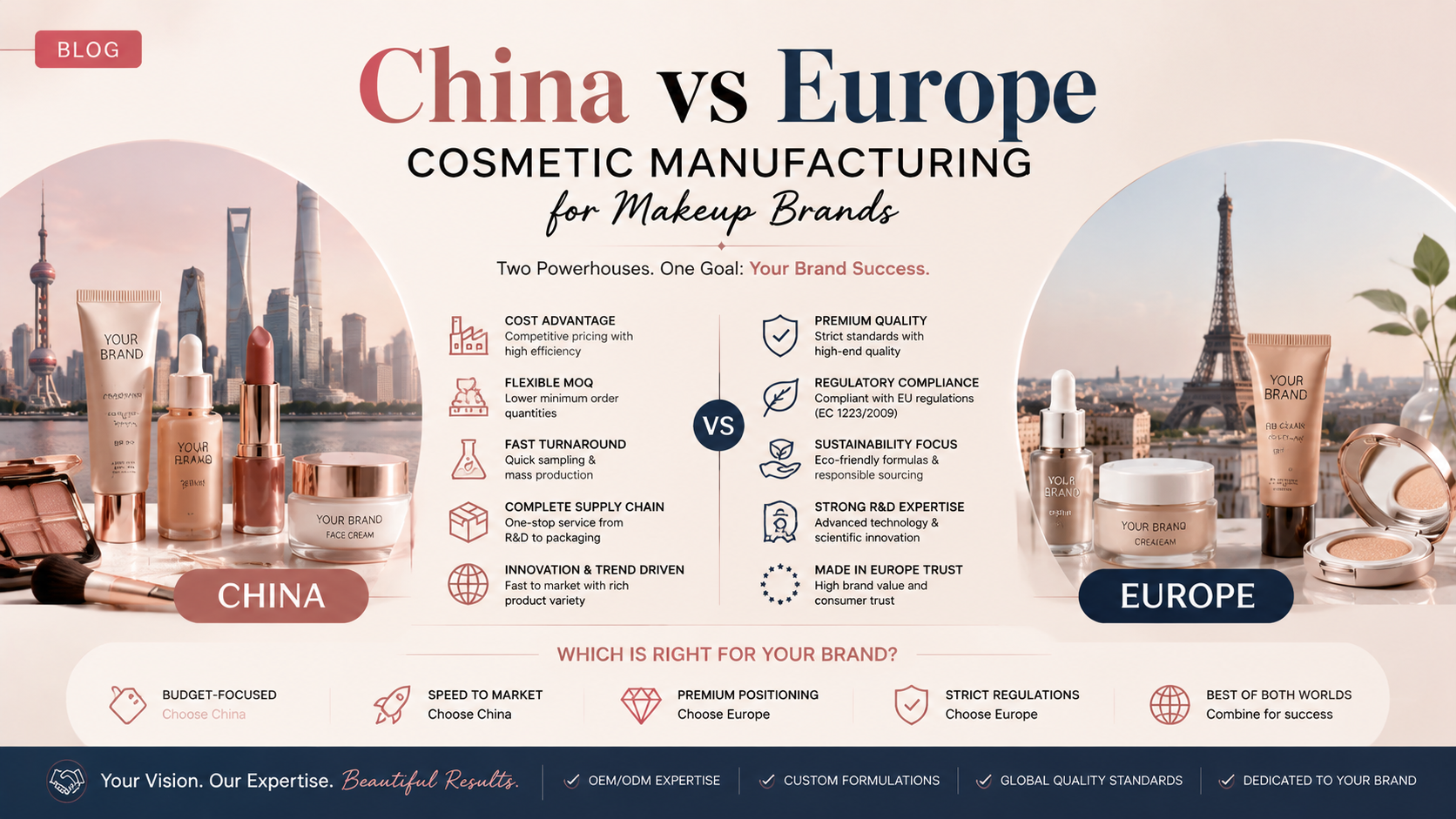
Cost competitiveness: China-based OEM/ODM partners usually have the strongest cost advantage for multi-SKU first launches, while Europe can be better for luxury perception.
Why brands choose the Middle East route
Brands choose Middle East suppliers or coordinators when they need local language, local channel knowledge, and retail relationships. This can be useful for buyers who are new to GCC compliance workflows or who need product-market feedback before committing to a large custom project.
Still, I advise founders to separate market access from manufacturing competence. A strong distributor does not always equal a strong factory. If the project depends on shade precision, formula stability, or packaging engineering, the buyer needs to know who actually owns those decisions.
How ZM Beauty compares as an OEM/ODM partner
I work with ZM Beauty as a China-headquartered OEM/ODM supplier with a UK branch and regular exposure to Europe and Middle East exhibitions. Our value for Middle East buyers is practical: lower entry MOQ on stock color cosmetics, formula and packaging customization, account-manager guidance, and a product range that covers common makeup launch needs.
Useful ZM pages for Middle East makeup buyers include , , , , and . The ZM foundation page highlights color adaptation, lightweight texture, long wear, suitability for multiple skin types, and customizable formulation and packaging (Source: ).
The honest limits matter. We should not be contacted for eyeshadow palettes, perfume, body wash, body lotion, hair wash or styling products, beauty tools, facial devices, or children's products. This article is only about color cosmetics manufacturing. For color cosmetics sold into regulated markets, we can help with support materials, but destination requirements must be confirmed during development.
Five sourcing questions
-
Can you prove heat and transport stability for my formula? Middle East distribution can punish weak packaging and unstable textures. Ask about compatibility, leakage checks, and stability testing.
-
Who owns the formula and packaging decisions? A trading office may coordinate well but still depend on another factory. Buyers should know who changes pigment, viscosity, applicator, and filling process.
-
What MOQ applies by SKU and customization level? A low MOQ may only apply to stock packaging or existing shades. Confirm MOQ for each shade, each component, and any custom carton.
-
What documents support GCC or destination-market registration? Ask for ingredient lists, MSDS, COA where applicable, GMP evidence, and any country-specific documents your importer requires.
-
How quickly can you support reorders? The first launch matters, but distributors make money on replenishment. Ask about reorder MOQ, packaging stock, and shade standard retention.
Risks and downsides
The first risk is confusing retail demand with product readiness. A Gulf beauty customer may be adventurous, but she still expects comfort, pigment, and packaging quality. The second risk is overbuilding the line. Too many shades can trap cash if the brand has not tested local preference. The third risk is weak label planning. Arabic, English, claims, ingredient names, responsible importer data, and batch details need attention before shipment.
Category advantages
The Middle East gives color cosmetics buyers clear commercial signals. Ulta is bringing 80 brands into the region (Source: ). Dolce & Gabbana Beauty plans up to 20 Gulf boutiques (Source: ). Vogue's 2026 trend reporting says bold makeup, heavy blush, lip liner, and eye makeup are returning, while Space NK expected strong double-digit color cosmetics growth building on 2025 (Source: ). Allure also points to stronger color payoff, cluster lashes, and serum-like base products in 2026 (Source: ).
For B2B buyers, that means the best opportunities are focused assortments: a high-shine lip gloss range, a long-wear lipstick set, a breathable foundation, or a blush/highlighter capsule, not a random 60-SKU catalog.
FAQ
Who are the best private label cosmetics suppliers for the Middle East?
The best supplier depends on the buyer. Local coordinators help with market access, European suppliers help with prestige positioning, and China-based OEM/ODM factories often help with MOQ, range, packaging, and cost.
Is China a good manufacturing choice for GCC beauty brands?
Yes, if the buyer chooses a factory with color cosmetics experience, documentation discipline, and export support. China can be strong for flexible MOQ, packaging variety, and multi-SKU launches.
What products should Middle East makeup startups launch first?
I would start with focused lip and face makeup: lip gloss, lipstick, lip liner, blush, highlighter, or foundation. These categories are easier to communicate and reorder than a broad mixed catalog.
What MOQ can ZM Beauty support?
For color cosmetics, stock products are generally 200-1000 pieces, custom formulas are generally 600-1000 pieces, and fully custom development is generally 6000-12000 pieces. Final MOQ depends on product and client requirements.
Can ZM Beauty help with Arabic packaging?
We can discuss packaging design, label direction, and documentation support, but exact destination-market wording should be confirmed with the buyer's importer, responsible party, or regulatory consultant.
Should distributors choose local or overseas suppliers?
Distributors should compare landed cost, reorder speed, documentation, product stability, and retail margin. Local communication is useful, but manufacturing control is often more important.