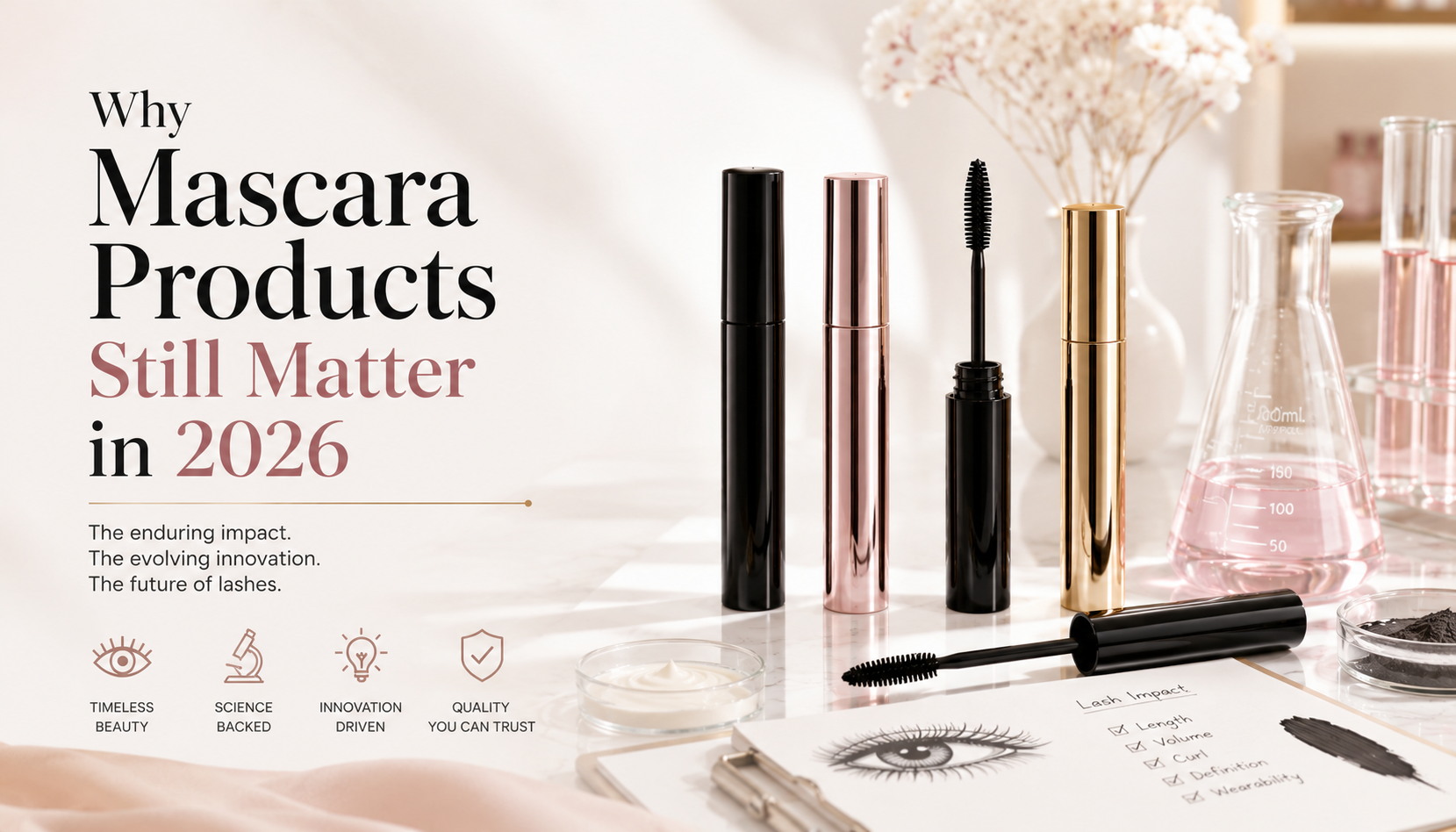
For startup brands, indie beauty labels, and established makeup companies expanding into eye products, mascara is not just another SKU. It is a repeat-purchase product with daily-use potential, high review visibility, and strong room for differentiation through formula, brush design, packaging, and claims.
Why Mascara Still Matters in Private Label Makeup
Mascara sits at the center of everyday eye makeup. Even customers who skip full glam often still want lashes that look defined, lifted, and fresh. That makes mascara a practical hero product for brands that want a compact launch assortment with strong commercial appeal.
The challenge is that mascara buyers are very specific. They notice flaking. They notice smudging under the eyes. They notice whether the brush reaches corner lashes. They also care about how the product comes off at night. A successful private label mascara should therefore be developed around a clear performance promise, not only a pretty tube.
For 2026, the most useful mascara positioning for many brands is simple: clean definition, flexible wear, easy removal, and a brush that matches the formula.
What Is Tubing Mascara?
Tubing mascara uses film-forming technology to wrap lashes in tiny flexible tubes. These tubes help create a smudge-resistant finish because the formula is designed to stay around the lash rather than migrate onto the lid or under-eye area.
The removal experience is also different. Many tubing mascaras can be removed with warm water and gentle pressure, so the tubes slide away without aggressive rubbing. For customers who wear makeup daily, that can be a meaningful comfort benefit.
Tubing Mascara vs. Traditional Mascara
| Feature | Tubing Mascara | Traditional Mascara |
|---|---|---|
| Main benefit | Smudge-resistant definition and easy removal | Volume, drama, curl, or length depending on formula |
| Wear story | Flexible tubes around lashes | Pigment, waxes, and polymers coating lashes |
| Removal | Often warm-water removal | Usually cleanser or eye makeup remover |
| Best customer fit | Daily wear, humid climates, contact lens users, minimal smudge routines | Full glam, high-volume looks, waterproof claims |
| Brand opportunity | Modern, clean, practical lash positioning | Classic lash transformation positioning |
Both types can work. The better choice depends on your brand's audience, climate market, price point, and hero claim.
Key Product Decisions Before Developing Your Mascara
Before choosing packaging or colors, a brand should decide what the mascara is supposed to do best. A formula that promises everything can end up feeling generic. A formula built around one strong benefit is easier to market and easier for customers to remember.
1. Define the Core Lash Effect
Most mascara products fall into one of four core directions:
| Lash Effect | Best For | Formula Focus | Brush Direction |
|---|---|---|---|
| Lengthening | Clean daily makeup, natural lash enhancement | Lightweight film and separation | Slim molded brush |
| Volumizing | Bold eye looks and glam routines | Buildable body and pigment | Dense fiber brush |
| Curling | Short or straight lashes | Flexible hold and lift | Curved brush |
| Defining | Office, school, mature beauty, minimal makeup | Clump control and precision | Tapered or micro brush |
For a first mascara launch, lengthening tubing mascara is often the most commercially balanced direction. It gives a visible result, supports a clean wear claim, and avoids the heaviness that can make formulas clump.
2. Match the Brush to the Formula
Mascara performance depends heavily on the brush. A great formula can underperform if the brush deposits too much product or fails to separate lashes.
Molded silicone brushes are useful for definition, separation, and clean application. Fiber brushes can create a softer, fuller look. Curved brushes help support lift. Micro brushes work well for lower lashes or precision application.
For a tubing mascara, a slim molded brush is often a smart starting point because it supports the product's natural strengths: separation, length, and controlled coating.
3. Choose Claims That Can Be Supported
Beauty customers are claim-aware, and retail buyers are even more so. Claims should be selected early because they influence formula testing, packaging copy, and marketing content.
Useful mascara claims may include:
-
Smudge-resistant wear
-
Flake-resistant finish
-
Warm-water removal
-
Lengthening effect
-
Clump-free definition
-
Vegan formula direction, where applicable
-
Cruelty-free brand positioning, where applicable
Avoid overloading the product page with claims that cannot be tested or explained. A focused promise is stronger than a long list that feels vague.
How ZM BEAUTY Supports Mascara Brand Development
ZM BEAUTY works as a professional color cosmetics supplier for brands that need flexible development, low MOQ testing, and practical launch support. For eye makeup, our product strength includes tubing mascara designed for smudge-proof wear and easy warm-water removal.
For new beauty founders, a mascara product can feel technically intimidating because the formula, brush, wiper, tube, and filling process all influence the final user experience. ZM BEAUTY helps simplify that development path by supporting formula selection, component matching, private label branding, and packaging execution.
Low MOQ for Market Testing
One of the biggest risks in mascara development is over-ordering before the product-market fit is clear. ZM BEAUTY's low MOQ-friendly approach, with many makeup items supporting starting orders from 100 pcs, helps brands test product concepts before scaling into larger production runs.
This is especially helpful for:
-
First-time founders validating a lash product idea
-
Influencer brands testing a limited drop
-
Retail brands comparing multiple brush options
-
Regional distributors testing climate-specific mascara demand
Packaging and Branding Beyond the Formula
Mascara packaging does more than hold the product. It communicates price point, brand personality, and user expectation before the customer even opens the tube.
ZM BEAUTY supports custom packaging and decoration options for makeup components, including hot foil stamping, UV coating, embossing, debossing, reverse UV, specialty paper, eco-friendly paper options, and gift set packaging. For mascara, these choices can be applied to outer cartons, sleeve packaging, bundle boxes, and retail display concepts.
A Practical Launch Framework for Private Label Mascara
Launching mascara is easier when the product is built around a clean commercial framework. The goal is to connect the formula, audience, and marketing message before production starts.
Step 1: Pick One Hero Use Case
Do not begin with "mascara for everyone." Start with one strong use case:
-
Daily office wear without under-eye smudging
-
Clean girl lashes with natural length
-
Humid-climate mascara for hot-weather markets
-
Lower-lash friendly definition
-
Soft glam lashes for beauty beginners
Once the hero use case is clear, formula and brush decisions become more focused.
Step 2: Build a Small Shade and SKU Strategy
Most mascara brands do not need a large shade range at launch. Black is usually the hero SKU. Brown-black or soft brown can be added for natural makeup audiences, mature beauty consumers, or markets where subtle eye definition performs well.
For a lean launch, consider:
| Launch Stage | SKU Recommendation | Why It Works |
|---|---|---|
| Test launch | 1 black tubing mascara | Keeps inventory simple and focuses reviews |
| Growth stage | Black + brown-black | Adds a softer daily option |
| Retail expansion | Mascara + eyeliner bundle | Builds a complete eye makeup story |
| Gift set stage | Mascara + brow gel + eyeliner | Increases perceived value |
ZM BEAUTY's eye makeup matrix can support this kind of assortment planning with tubing mascara, brow styling gel, semi-permanent brow tint, and creamy gel eyeliner.
Step 3: Prepare Content Before Production Finishes
Mascara needs demonstration. Before launch, brands should prepare content that shows:
-
One-coat vs. two-coat results
-
Brush close-ups
-
Wear test moments
-
Removal with warm water
-
Lash separation from different angles
-
Before-and-after application on different lash types
These assets help customers understand the formula before they buy and give distributors or retailers stronger material to evaluate.
Common Mistakes to Avoid
The first mistake is choosing the tube before the formula. Packaging is important, but mascara is performance-led. If the brush, wiper, and formula are not aligned, the product can feel messy even when the packaging looks premium.
The second mistake is trying to make one mascara deliver every effect. A tubing formula is naturally strong for clean length, definition, and smudge resistance. Let that be the center of the story.
The third mistake is ignoring removal. Customers often remember how mascara comes off as much as how it wears. A warm-water removal message can make the product feel more daily-use friendly.
The fourth mistake is launching without enough application content. Mascara is visual. Brands should show texture, brush design, lash finish, and wear behavior clearly.
FAQ: Private Label Tubing Mascara
Is tubing mascara good for a new makeup brand?
Yes. Tubing mascara gives new brands a clear product story: smudge-resistant wear, clean lash definition, and easy removal. It is easier to explain than a generic mascara and can work well as a focused hero SKU.
What brush is best for tubing mascara?
A slim molded brush is often a good choice because it helps separate lashes and control product deposit. However, the best brush depends on whether the brand wants length, curl, volume, or lower-lash precision.
Can mascara be customized for private label brands?
Yes. Brands can customize formula direction, brush type, component style, tube decoration, outer packaging, and product claims. ZM BEAUTY can support private label makeup development from product selection to packaging execution.