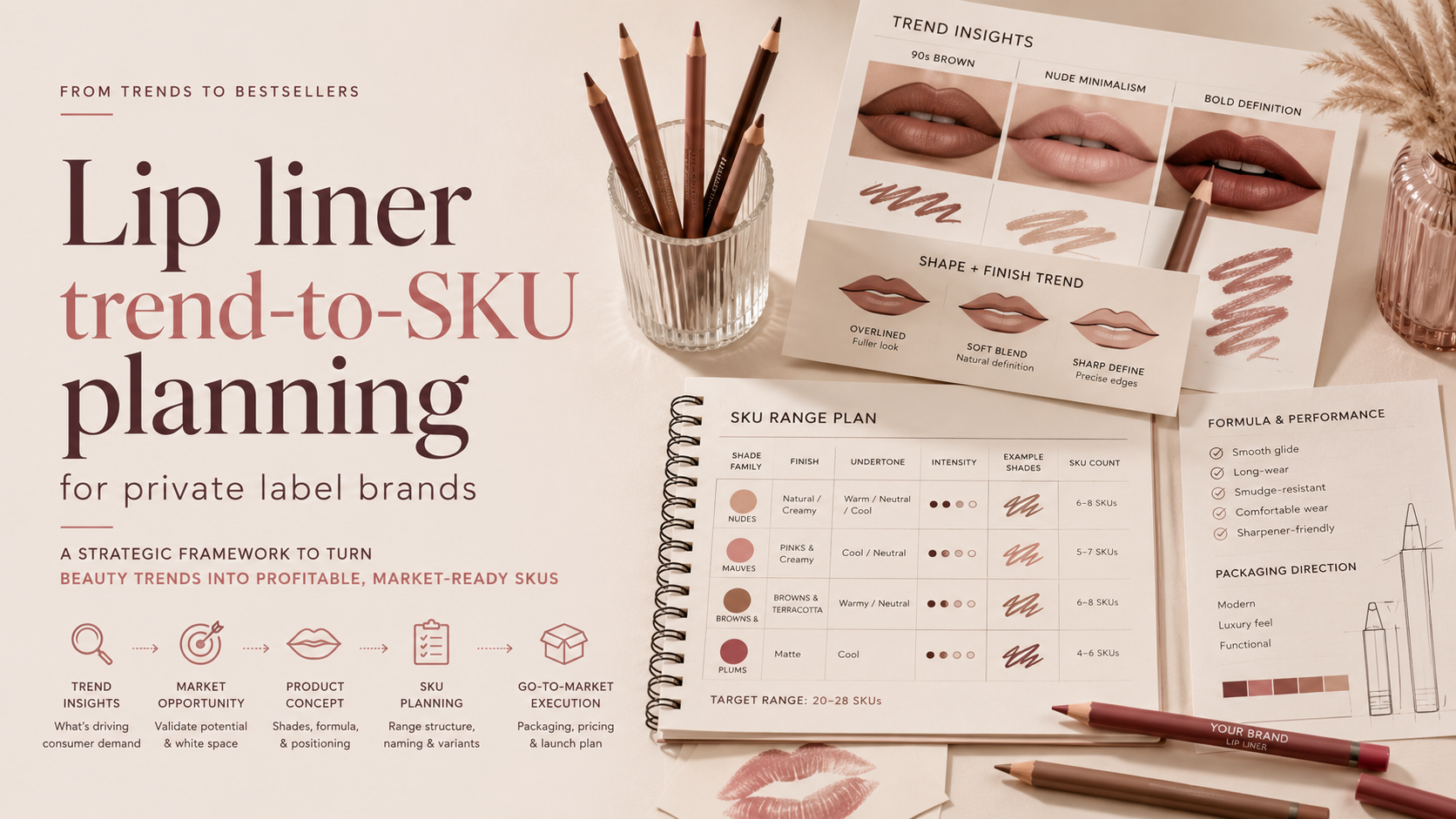
The better question is not "How many brow products can we launch?" It is "Which brow product earns the first reorder?" Brow consumers are comparing hold, stroke precision, shade realism, and whether the finish looks natural in daylight. Recent brow-gel testing by InStyle covered 43 products over two weeks and judged hold, definition, volume effect, and long-wear performance, which tells us how demanding the category has become (Source: ). People also tested 23 brow gels and focused on hold, application, ease of use, residue, and flaking, all practical signals a buyer should convert into a supplier brief (Source: ).
I work with ZM Beauty on OEM/ODM beauty projects, and for brow makeup I prefer a launch map that keeps the first order focused. ZM Beauty's public all-cosmetics page lists private label cosmetics, turnkey solutions, contract manufacturing, 10,000+ ready-to-go formulas, 1,000+ packaging options, and 300+ popular shades for global buyers, which is useful when a buyer wants speed without losing product direction (). The key is to use that range with discipline.
The three-SKU brow launch map
For most first-time brow buyers, I would rather build a three-SKU system than a crowded six-SKU system:
| Brow role | Best first format | Why it matters | What to postpone |
|---|---|---|---|
| Shape | Micro pencil or fine pen | Creates realistic missing hairs | Heavy pomade unless your audience already wants bold brows |
| Set | Clear or tinted gel | Gives instant lift and hold | Extreme lamination claims until wear testing is proven |
| Fill | Soft powder, tinted gel, or wax-gel | Adds density without harsh edges | Too many undertone variants in the first order |
This map is not meant to limit the brand forever. It protects the first launch from avoidable complexity. If the shape product sells faster than the set product, we can adjust the second order. If the gel becomes the hero, we can expand tinted shades later. The first brow launch should teach the brand something about its customer, not trap the brand in unsold inventory.
Who What Wear's 2026 brow-pencil guide highlights the current consumer preference for micro-fine pencils that create hair-like strokes instead of thick, obvious lines (Source: ). Cosmopolitan's 2026 brow-gel testing focused on stiffness, applicator design, flaking, and wear, which means buyers should brief those exact details before sampling (Source: ). These are not abstract editorial points. They become formula viscosity, brush size, film former level, pigment load, and packaging wiper control.
Trend signals also support a tighter brow routine. Teen Vogue's 2026 brow trend report named straight brows, fluffy brows, thin brows, natural brows, and lighter brows as five style directions, which tells me one formula family will not answer every buyer persona (Source: ). Who What Wear's clear brow gel guide called out flake-free finish, natural hold, firm hold, and Gen Z brow styling behavior, which are the same points a private label buyer should inspect during sampling (Source: ).
Shade logic before packaging design
Brow shade mistakes are expensive because the product sits close to the face and hairline. I usually ask buyers to approve shade direction before final packaging decoration. A brown that looks fine in the component can turn warm, red, gray, or too dense once it is brushed through real brow hair.
For a small launch, we can often start with:
-
Taupe or soft ash brown for blonde to light brown users.
-
Neutral brown for the widest commercial middle.
-
Deep brown or soft black for dark hair users.
-
Optional auburn only if the brand already has redhead demand.
This is where I push back on "one universal brown." The market has moved past that. InStyle's 2025 brow-gel testing called out formulas aimed at blonde and redhead-friendly shades, showing that undertone is part of buyer evaluation, not a luxury add-on (Source: ). Allure's 2025 eye makeup awards included brow products across pencil, gel, pen, and powder formats, which also shows the category is not judged by one format alone (Source: ).
When we prepare samples, I want the buyer to compare each shade in three states: direct swatch, brushed through brow hair, and photographed under daylight. A pencil can look perfect on paper and still read too orange on the face. A tinted gel can look soft in the tube and then deposit too much pigment because the wiper is too open. Shade approval needs a use test, not only a lab dip.
Formula choices that change the user experience
Brow makeup feels small, but the formula decisions are technical. A micro pencil needs glide without breakage. A brow pen needs controlled flow and a tip that does not dry after a few uses. A gel needs hold without flakes, residue, or crunch. People noted that one tested clear gel took about three minutes to set, while another waterproof and transfer-proof formula claimed up to 16 hours of hold (Source: ). Those numbers matter because they shape user patience and claim language.
For brow gel, I ask five factory-side questions before I trust the sample:
| Issue | What we check | Buyer risk |
|---|---|---|
| Wiper control | Does the brush carry too much product? | Clumps, flakes, poor reviews |
| Dry-down | Is there enough styling time before set? | User cannot shape brows evenly |
| Film flexibility | Does hold feel stiff or comfortable? | Crunchy finish and repeat-use drop |
| Pigment deposit | Does tinted gel stain skin too much? | Harsh brows in daylight |
| Brush geometry | Does the spoolie fit thin and full brows? | Product works for only one brow type |
At ZM Beauty, we can discuss formula adjustment, texture, color, packaging design, sample requests, and MOQ during development (). I still prefer to define the hero user before samples begin. A salon brand may want a stronger hold. A clean everyday brand may want a soft finish. An e-commerce startup may need a shade set that photographs clearly on model content.
If the brow line will sit beside other color cosmetics, I would also look at ZM Beauty's to plan routine bundles and shade-family consistency across face content.
MOQ planning for a brow makeup launch
MOQ should follow product risk. For color cosmetics, our internal rule is stock products at 200-1000 pieces, custom formula at 600-1000 pieces, and fully custom development at 6000-12000 pieces. The final MOQ depends on exact product and client requirements and must be confirmed by the account manager.
For a brow line, I would normally split the plan like this:
| Launch stage | Best route | Reason |
|---|---|---|
| Market test | Stock or semi-custom formula with brand packaging | Lower risk and faster feedback |
| Second order | Add one shade or improve applicator | Uses real customer data |
| Mature line | Fully custom texture, brush, and carton system | Worth it when repeat demand is visible |
I do not recommend starting with fully custom brow packaging unless the buyer already has proven demand. A custom micro pencil body, custom spoolie, custom tip, and custom carton can be right for a larger brand, but a first launch needs cash left for content, sampling, and reorder stock. The states that ZM Beauty was founded in 2017 by Grace and supports entrepreneurs with customizable beauty products, one-on-one account manager support, and flexible MOQs. That support works best when the buyer is honest about stage and budget.
Compliance and claims to control early
Brow products sit near the eye area, so claim discipline matters. In the United States, cosmetics must be safe for consumers under labeled or customary conditions of use, and labeling cannot be false or misleading (Source: ). In the EU, cosmetic products are governed by Regulation (EC) No 1223/2009, including safety and responsible-person requirements (Source: ).
That means I avoid loose promises such as "permanent brow lift" or "growth effect" for a brow makeup product unless the formula, testing, and destination-market review support the claim. ZM Beauty can assist color cosmetics clients by providing required materials so clients can register CPSR themselves where relevant, but we should not claim that completed CPSR is automatically provided for all color cosmetics.
Five sourcing questions for brow makeup suppliers
-
Can I test the same brow gel on thin, medium, and full brows? A gel that works on one brow density may overload another. We need the applicator and formula to work across the target audience.
-
How many shade revisions are included before bulk approval? Brow undertones are sensitive. I want revision rules clear before the buyer receives the first round of samples.
-
What happens if the pen tip dries or the pencil breaks during transport testing? This is a packaging and filling issue, not just a formula issue. A supplier should explain the test plan.
-
Can you separate stock, semi-custom, and fully custom MOQ? A buyer should not be pushed into full custom work when a market test is more sensible.
-
Which documents can you provide for my destination market? MSDS and COA may be available where applicable, and country requirements need confirmation during development.
Who should not start with brow makeup
Brow makeup is not ideal for every buyer. If you need one color to fit every hair color, the brief is too weak. If you want medical-style growth claims from a makeup SKU, the claim direction is wrong. If your order quantity cannot support even a controlled shade set, we should talk about a simpler hero product first.
I also need to be clear about product scope. ZM Beauty's wider business includes color cosmetics, lash products, growth products, and selected skincare, but this Blog strategy is about brow makeup as color cosmetics. ZM Beauty does not focus on eyeshadow palettes, perfume, body lotion, body wash, shampoo, conditioner, beauty tools, devices, or children's products. Buyers requesting those categories are not the right fit for this brow makeup project.
FAQ
How many brow SKUs should a new brand launch first?
I usually prefer two or three: one shaping product, one setting product, and possibly one filling product. That gives the brand a complete routine without overloading MOQ, shade approval, and inventory.
Is clear brow gel safer than tinted brow gel for a first launch?
Clear gel can be easier because it avoids shade mismatch. Tinted gel can be stronger commercially if the audience wants fullness, but it needs careful pigment deposit and shade testing.
Can we make vegan or cruelty-free brow makeup?
We can discuss vegan and cruelty-free positioning where the formula and material choices allow it. I avoid promising that every product is automatically vegan or clean until the exact formula and packaging are reviewed.
What MOQ applies to brow makeup?
For color cosmetics, stock products are usually 200-1000 pieces, custom formula is 600-1000 pieces, and fully custom development is 6000-12000 pieces. Final MOQ depends on the product and client requirements.
Should I launch brow pencil or brow gel first?
If your audience wants precision, start with pencil or pen. If your audience wants lifted, brushed-up brows, start with gel. Many brands eventually need both, but the first hero should match the strongest use case.
Can ZM Beauty support packaging and formula together?
Yes, we can discuss formula, texture, color, packaging, logo, label, samples, quotation, and compliance documentation support. I recommend approving the user routine before finalizing packaging decoration.